Category: Short Stories

  • Military Issue

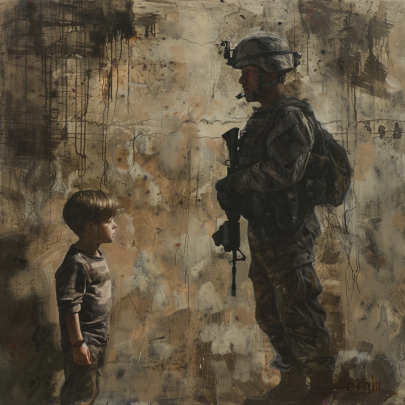
              “Mom, I want to be a soldier,” Danny said as he climbed from the sandbox.  His miniature army, scattered about the sand dunes and valleys, had won a great victory against the bent twigs from the neighboring tree.  As I brushed the sand from his clothes and helped him gather his troops, I thought about what it might be like to have a son in the army…someday.

              Although he was only six, I could not imagine him becoming good at what he would learn in basic training.  Things such as tanks, guns, grenades, and everything in-between that could maim or kill another person.  Mothers always imagine their children being the best they can be in professions such as medicine, science, academia, or anything else but being trained in weaponry.  The army was not on my list of things I wanted for him.

              As Danny meandered his way through elementary school, he and I talked a lot. Long conversations. Loud conversations. Always talking. Always debating one thing or another. The topic did not matter…all that mattered was that we talked.  Danny was taught to question what was said and to never take things at face value.  I instilled in my child the quest for truth, the story behind the story.

              “Danny, what do you want to do with your life?” I would often ask between the ages of six and ten.  “Mom,” Danny would say, “I’m not sure, but I’d like to do things differently.”  For instance, the first time Danny was confronted with reading Shakespeare, he read all his plays at once.  When I asked him why he did this, he replied simply, “I’ll have to do it in high school, so I’ll just get it over now. I only must refresh my memory later.”  As with any other child his age, rules were made to rebel against.  He wanted to do everything his way, on his timeline. We would often butt our heads over rules.  If there was a shortcut to getting things done that would circumvent the rules, Danny would do it.  He honed the fine art of genteel rebellion against authority to new levels.  He never openly rebelled, he just structured things so that you knew he was up to something.  You just couldn’t put your finger on what it was.

              Danny never let go of the thought of being a soldier.  He delighted in going to his father’s home and having mock battles in the woods that surrounded his house.  While there, his father taught Danny about firearms and taught him to shoot.  Danny became an excellent marksman.  He would come home from there full of soldier talk and battle plans which would make me inwardly cringe.  It seemed to me that by now he should have shed this idea along with the sandbox and its toys.  But he never did.

              As Danny moved into adolescence, he began developing his own style.  As he began expressing his own tastes, he also felt the need for a more grown-up name.  He wanted to be called Daniel.  His clothing choices were surprising.  He refused to wear anything other than black and some white.  Not any other color, especially green.  He hated green.  He did not want to dress and look like all the other boys.  There were no creases in his pants, no ironed shirts, and no alligators on the chest.  He lived in T-shirts and jeans.  He set his own style that reflected his outlook on life and how he saw himself as an individual.

              As Daniel moved through his teen years, I continued to ask him what he wanted out of life.  I was still hoping that his answers were not related to the military so I could quit worrying.  I did not have anything against military service, but this was my youngest son, my baby, the one I worked so hard to be friends with.  Every day he struggled with boundaries, rules, and regulations.  How could he want to be a soldier when he fought the daily regime of everyday life?

              “Daniel, you are a sophomore now.  Three more years and you’re on your own.  Thought about your future? You need to figure this out.”  I would ask. It seemed no matter what we were talking about, the subject of the military would pop up along with our toaster pastries in the morning.

              “Mom, I still have time,” he would say.  “I am only 15.  Don’t worry.  I’ll live with you forever.”  In a way, this is what I dreaded but also what I hoped for.

              On a hot day in late June, we celebrated Daniel’s 17th birthday.  Our tradition was to give three presents – two surprises, the third one of their own choosing.  As Daniel got older, the presents got more expensive.  He had chosen well during those years, everything from a Super Nintendo to a CD player and sound system for his room.  I always dreaded the third present.  Daniel, in an unusual move, asked for a rain check.  He will let me know later.  “No sweat,” I said.  “Great,” I was thinking, “maybe I can save more money for this one.”  I fully expected the request for a car to be heading towards me.

              The next day Daniel called me.  “Mom, I know what I want.  Meet me at the mall after work, okay?”  When I met Daniel at the Mall, he quietly escorted me to the Army Recruiting Station. He placed his hands on my shaking shoulders and looked down into my uneasy face.  He said, “Mom, I want to be a soldier and I want to be called Dan.”

    As a parent, I tried to instill in Dan strength of character, determination, and pride.  I tried to provide him with good skills in making decisions and judgments.  I supported his decisions if they were safe, harmless ones.  Now I was being asked to hand him over to strangers – strangers who did not look at life the way I did.  Strangers who were proficient with tanks, guns, and grenades.   This was not a safe, harmless decision.  How could I do this?  How could I live with this decision?

              I did this thing.  I signed my son over to the Army.   I provided him with the one thing he wanted all his life . . . to be a soldier called Dan.

  • Feeling Home

    I am at the time in my life where I should be settled. I am supposed to have dug in my heels, planted my feet down in one spot and grown roots. I am supposed to have figured out where, and what, home is. I have never felt “home”. Home has always been my mother’s place, or my sister’s place, but never MY place.
    When I bought my house, I told myself, “Finally, this is it. This is HOME. Here is where I will raise my last child. Here is where I will die.” Now, years later, I am looking beyond the privacy fence, searching the horizon for whatever befalls me. I saw this child leaving, searching out his new home with the Army; for myself, I saw a new home and a life reborn in the Sonoran Desert.
    What was prompting this migration? How could I possibly give up this contented, sedate way of life here in Arkansas? I could spew forth several reasons, all of them perfectly sane, all of them perfectly crazy. I am looking homeward. I was looking for the inner calm I once found in the desert.
    I discovered the desert when my parents moved to Tucson in the mid-70’s. They were pioneers – they left behind the Ozarks where the family had spread through all subsequent generations. When I visited, I immediately fell in love. I loved the heat, the scorpions, the cacti. These things spoke to me of hearth and home. I never wanted to leave. I wanted to die there. But while I did not die, I did leave only to return. I wanted my children to fall in love with this strange, alien topography as quickly as I did. They, too, enjoyed wandering through the sand dunes, crouching under the giant arms of the Saguaro, avoiding the long, spiny arms of the Ocotillo. They quickly became “desert rats” browning in the sun much like the bread I used to bake browned in the oven. Baking their souls, as it were, to a healthy golden glow.
    There has always been something about barren, deserted landscape that appealed to me. Somehow all tension and stress were stripped from my carcass, leaving bare bones, bleached white, resembling a cow skull stripped clean by vultures. This sandy, extreme world. You either love it or you hate it. No in-between, no indecisiveness. This is its appeal. It’s an “all or nothing” kind of place.
    So why did I leave Tucson? Love, marriage, still seeking a place to call home were the magnets pulling me back to the Ozarks. Once here, I achieved success in all I attempted, but still, I had no place that felt “home”. As I aged, I realized that “home” was not “where” I was physically but “where” I was mentally.
    My mental persona has never left the desert. I am still there on days when the 125-degree summer sun scorches everything into brittle gingersnaps. I am still there when the night temperatures drop into the 30’s and you pray for midday. Pray for relief from the extremes. What am I seeking through these prayers?
    Am I seeking justification for these decisions that took me back and forth across this country? Do I want approval for the major life changes caused by the decisions I made? I think I am seeking a new life, perhaps a refreshing purpose to my life. A return to my mental home. Leaving behind a house in a land suffocating with green for another house surrounded by cacti and scorpions.
    Once there, settling into this new life, this new perspective, would I stay? Did I find what I was seeking? Or will I, after a few years, again feel that tug, that yearning to search alien places? I don’t know. I should let that inner calm I found in the desert pull my soul down through my feet and root it in sand. I must allow this calm to flicker and grow in the heat, allow the monsoons to drench it with rain, and inhale deeply of desert flowers in the springtime. My soul should wax and wane with the seasons, having time to become fixed, rooted in permanence. But will I?
    There will be adventures to come and other souls to meet. Will this happen? Where will it happen? When will it happen? I don’t know. I just hope and trust that one single experience will be strong enough to make me feel like I am home.

  • Musings About George

    I always wondered what it would be like to live in the same town forever. To know that my parents, grandparents, and all my ancestors had lived in the same town since the town was first born. The cycle was broken with my parents who moved a great deal when we were young, about every two years.

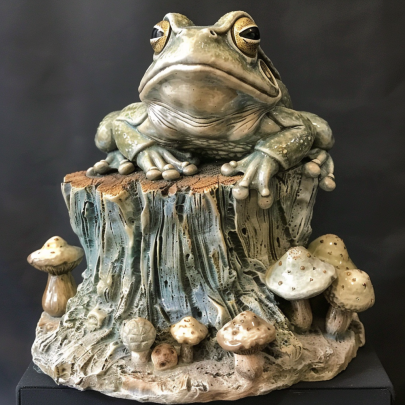
    Because my family frequently moved, I never developed any lifelong friendships. I never got to know anyone long enough. As I grew older, I never had girlhood memories to share with anybody over the phone as my children bustled underfoot. I always looked for a friend like that, worked hard to develop one in the short time spent anywhere. A friend with whom I could be my crazy, riotous, unpredictable self. I never managed to find one until George entered my life. No, he was not my husband. He is a ceramic bullfrog on a stump in my yard.

    This stump is all that is left of a tree. I do not know what type of tree it was. I just know it is a magnificent stump. Its stubby height, covered with patches of scaly bark, looks more like a child in the last stages of chicken pox than a tree. It is not very big around, all gnarly and twisted. During warm summer rains, this stump explodes with toadstools. These toadstools give it the appearance of some grotesque alien about to declare war on your knees. It is a comforting stump. It has developed character and oneness with its surroundings that I find refreshing.

    When George first appeared two years ago, he was sitting silently on this stump. I had gone out to plant tulips when I saw him. Staring straight ahead, with a contented air about him, he seemed to settle in for a spell. George is constant, stationary, always predictable. I would always go and talk to him. Just the other day, I was upset with my boss. “George,” I said, “this man can be so insensitive. He is the biggest eavesdropper I know. He shamelessly listens in on every conversation in my office.” What did George say? Nothing. He sat there silently.

    He is the one friend I had searched for. The perfect friend who never tells me what to do. “What should I do about my co-worker’s problem?” I would ask. George would say nothing. He never suggests courses of action. His advice is never wrong because he never gives any.

    “What would happen if I quit everything and just disappeared? Do you think anyone would care? Should I tell everyone what I really think?” George, as usual, gave no indication of approval or disapproval. No thought is ever too crazy, too bizarre, to share with George. He never condemns. He is that one friend I have looked for all my life. The one I wanted to share my deepest secrets, my brightest hopes, with.

    “Let me tell you what happened,” I would breathlessly whisper to George. I shared with him all those things I dared not tell another human being. Deep, dark secrets. Things that I would never speak about to another person. I knew my secrets would be safe. He could never tell my secrets because he could not speak.

    I often wondered about his background. Has he been as restless and rootless as I have been? Had he sat patiently on some store shelf waiting for someone to accept him, take him home? I have asked him these questions. But he never answers. I stare into his incredible hazel eyes and see nothing. It’s as if his only purpose is to become what I need, a friend that will always be there. He has stuck by me in all seasons, from the turbulent springtime through the howling winter winds with the snowflakes coating everything in white deliciousness.

    Just as I need a home, need friends, need a base, George needs a stump. I know that wherever my roaming in this world takes me, George will go along. I can’t imagine life without him.

  • A Woman Lost and Found

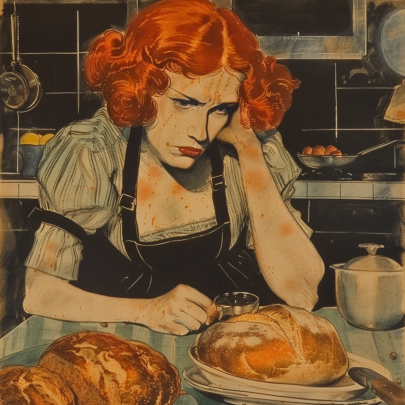
    It is funny, you know, but as I was standing at my kitchen sink the other day feeling anger and frustration over some petty thing, I began thinking about the last time I baked bread. I forget the type of bread that it was, but I remember the smell. I remember how the aroma drifted from room to room, searching you out, catching your entire being, and wrapping it in the smell. The smell of bread baking always meant that I was home and that I was angry.

    As a young woman, I was coached by my mother and her contemporaries to believe that no matter what it was about or who was at fault, a young lady, never, ever expressed negative emotions. Many things were forbidden in my younger days. All the really great things, you know, like telling someone what you really thought, or throwing a temper tantrum, were not acceptable character traits for a young lady. Along with these taboos, a young woman was subtly taught that men were perfect, men were brilliant. Women were not capable of doing anything other than having children and running a household. Men went to college to be somebody and do great things. Women went to college to get a husband…preferably a doctor.

    Fortunately, I did not completely tumble into this deep chasm of ignorance. I teetered on the brink. I partook of the forbidden things. I had a temper. I was difficult. I did not go to college. I found a husband on my own. A cool guy in a ’55 Chevy. During our early married years, I allowed the fantasy to perpetuate that he was the brilliant one. (He did not finish high school.) I finished my senior year with a young son on one arm, a home to keep, a part-time job, and a husband to dote on. I was not intelligent enough to make decisions about our future, but I was ‘bright enough’ to take care of these few simple things.

    As I began to mature into my early twenties, I felt that something was wrong, I just didn’t know what it was. I was angry. I was resentful. I could look and see the good things in the world and wonder where they were for us. I worked hard at my job, worked hard at home with my children. I worked harder at keeping my husband happy. I became angrier. I baked bread more often. The more I baked, the happier my husband seemed. He seemed to savor my baking days as much as he savored his time away from home.

    In reality, baking bread is a mindless act. It doesn’t take much intelligence or effort to measure, mix, and set to rise the basic ingredients. It doesn’t take much more to knead the dough. One odd thing about bread, the more you knead, the better the loaf. If I were particularly angry, I would bake French bread. This dough required much kneading. It was a ‘tough loaf’ to create. I won blue ribbons for this bread. With all this baking, my husband did not realize that for me this was an exercise in futility. While it allowed me to displace my anger, it also served to nourish him. It allowed him to ‘live another day’ to make me angry, to bake more bread.

    There is usually a climactic moment in your life that wakes you up, shakes you up, or tears you down. For me, that moment came during my late twenties. By this time, we had three children. I worked full time outside the home, managed the home, orchestrated our children in their daily activities, and took absolute care of my husband. This prince of princes lacked for nothing. From the time he came home from work until he left the next morning, he did nothing he did not want to do. Struggling financially, I felt our only way out of this morass of poverty was education, I strongly believed that with an education we could do more than survive. We could have a future. I also believed that the perfect job for me would be teaching, allowing me daily contact with our children. They would not be left with substitute mothers. All that stood in my was a husband and four years of college.

    While I do not remember the words of the arguments, I’ll never forget his tone and my reaction. He strongly felt that furthering my education was not necessary. I had to remain outwardly less educated than he. As this argument ran its course over several weeks, I continued baking. I do not remember what made me insist on going to college. There was nothing about me that would cause me to rebel in this manner.

    A decision was finally reached. I would be ‘allowed’ to go to college. I would be ‘allowed’ to get an education. Things must remain the same at home. For a while, things did. I rose early, baked bread, fed the family, packed lunches, cleaned house, went to classes, worked full-time, came home prepared supper, cleaned house, took care of the children, and doted on my husband. Study time did not begin until 11:00 pm and would last several hours. Angry still, I learned to endure. My anger was the leavening for my endurance. For a time, this was not bad. I was still a lost woman, I was still baking bread, but I was waking up. I was on the path of becoming.

    There were many components on this path that helped. Courses such as assertiveness training and psychology, having strangers telling me that I had a brain and could use it for something over than measuring flour and water helped. The more I learned, the less and less I baked bread.

    What happened to this woman? Unexpectedly, I found a whole new life on my own, divorced, somewhere between the bleached, refined flour and the robust, full-bodied whole wheat. I found a voice. I found myself. I found no anger left within me. I found no need to bake bread.

    I became a Woman of the Lost and Found.